

Texas’s history of deep-water ports has been shaped by evolving trade demands and infrastructure innovation for more than a century. Prior to 1845, ports like Galveston and Velasco primarily traded with New Orleans, with Galveston later emerging as a major cotton exporter to Britain by the mid-1800s.
Post-Civil War growth in ocean commerce and railroads increased port traffic, but shallow-water ports struggled as vessels grew larger. This spurred efforts to build true deep-water facilities. The most transformative development was the dredging of the Houston Ship Channel in 1914 and the creation of what is now Port Houston, cementing Houston’s role in international shipping.
More recently, Texas Deepwater Partners was launched in 2015 as a joint venture to build an energy logistics terminal along the Houston Ship Channel. Spanning 988 acres, this multi-modal facility supports liquid storage and transport, boosting export capacity amid rising energy production.
Together, these milestones have underscored Texas’s strategic role in global trade and energy logistics.
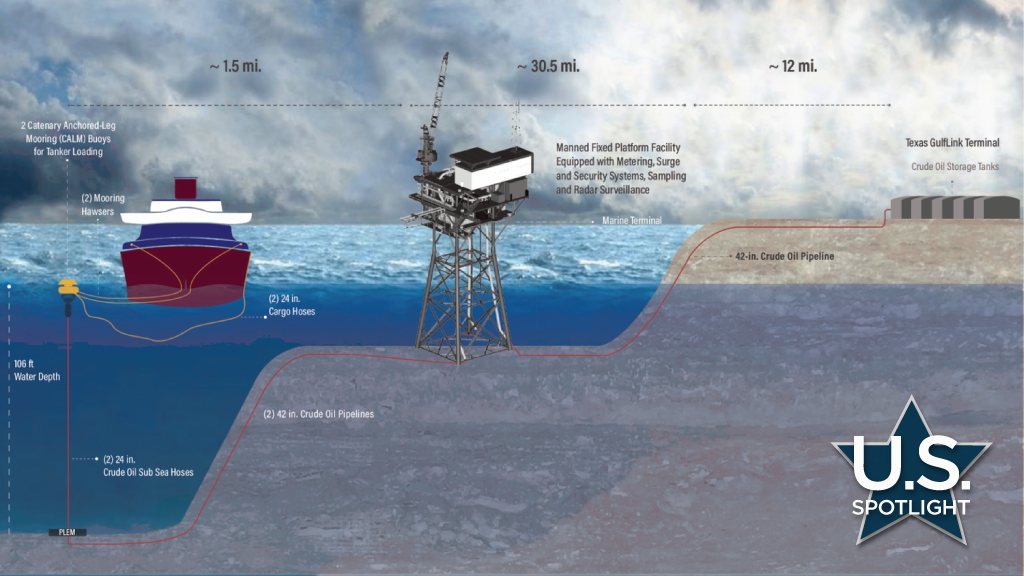
Today, the Iran war finds U.S. oil exports reaching record levels. In response, Sentinel Midstream, a Dallas-based energy infrastructure company, is set to construct a multibillion-dollar offshore oil-shipping hub in the Gulf of Mexico approximately 30 miles off the coast of Brazoria County, just west of Freeport.
The is the result of financial support from the unusual combination of Japan and the Donald Trump administration, and comes at a time when private U.S. energy developers are reluctant to shoulder the financial risks of such projects without first securing long-term commercial contracts.
According to the U.S. Commerce Department, the will contribute an estimated $2.1 billion, the project’s originally announced cost.
Commerce Secretary Howard Lutnick the project will “reinforce America’s position as the world’s leading energy supplier.”
Sentinel Midstream’s Texas Gulflink Deepwater Crude Oil Export TerminalStatusConceptualValue$75MLocationFreeport TX 77541SectorPrivateTypeIndustrial · New ConstructionData as of July 27, 2026 will create a deep-water crude oil export terminal capable of loading Very Large Crude Carriers (VLCCs) offshore, thereby streamlining U.S. crude exports. Initial plans began in January 2026 after the U.S. Maritime Administration granted the project its deep-water port license.
On May 4, Sentinel Midstream announced the funding from the U.S.–Japan Trade Agreement. Construction began immediately afterward, promising job creation in Brazoria County and expanded global market access for U.S. producers.
The project will support the creation of up to 720 jobs for construction and operation the U.S. Transportation Department and is expected to begin operations in 2028. The terminal is designed to handle up to two million barrels of crude oil daily while improving efficiency and reducing environmental impact.
“Texas GulfLink is about more than infrastructure, it is about unlocking the full potential of American energy,� Sentinel CEO Jeff Ballard. “This project creates a direct path from one of the most liquid crude hubs in the world to global markets, strengthening our allies, improving trade dynamics and reinforcing the United States as the supplier of choice in an increasingly uncertain energy landscape. We are proud to be a trusted partner of both the U.S. and Japan governments and help lead the next chapter of American oil exports.�
It is expected the result will be the opening of new international markets for growing domestic crude production. VLCCs are considered the ideal vessels to serve these markets, Sentinel , particularly those in Asia. However, their deep drafts make full loading at existing near-shore ports both costly and inefficient.
Traditionally, VLCCs are loaded through “reverse lightering,” where up to four smaller tankers shuttle crude oil from the port to the larger vessels anchored offshore, a repetitive, emissions-heavy process. Sentinel says the Texas GulfLink offers a smarter alternative.
By loading VLCCs and other tankers directly at an offshore terminal, overall emissions will be cut by roughly 86 per cent compared to reverse lightering. This direct-loading model also eases congestion at nearshore ports, boosting both environmental performance and maritime safety.
A standout feature of the terminal is its active vessel-based vapour recovery system using a dynamic-positioned support vessel, the first of its kind in the U.S.
The vapour recovery system pulls alongside VLCCs during loading to capture volatile organic compounds (VOCs) and condense them into a marketable liquid product. This innovative approach is expected to prevent up to 19,000 tons of VOCs, including hazardous air pollutants, from being released into the atmosphere each year.
The offshore environment is dynamic and unpredictable and oil tankers have become larger, the company explains.
This is why it is critical for any offshore installation be designed, constructed and operated with the utmost care and consideration of the risks posed to the health and safety of the environment and the personnel involved. For those reasons, every aspect of the Texas GulfLink deep-water port has been thoughtfully designed by professionals and engineers with decades of relevant experience, Sentinel . Ìý
U.S. Transportation Secretary Sean Duffy the Texas GulfLink project directly supports efforts to boost the U.S. domestic oil industry, positioning American producers “in the driver’s seat.â€� He added it also ensures the world can look to the United States rather than to foreign adversaries for its energy supply.
Recent Comments
comments for this post are closed